July 05, 2026 | by: Kuoda Authors


Almost everyone travels through Peru following the same route. Lima, Cusco, the Sacred Valley, Machu Picchu, and home. It is a magnificent journey, and we would never talk anyone out of it. But it is just a narrow slice of a country that holds the driest desert on earth, a large share of the Amazon basin, canyons more than twice the depth of the Grand Canyon, and ruins that were already old when the Inca arrived. The Peru most people picture is real. It is just not the whole picture.
What follows is not a consolation list for travelers who have “already done” Machu Picchu. It is a way to experience Peru beyond Machu Picchu, where we send people when they want the feeling that has become almost extinct in modern travel: the sense of arriving somewhere that has not yet been smoothed over for visitors.
The North: Kuélap, the Chachapoyas Cloud Forest, and Cajamarca
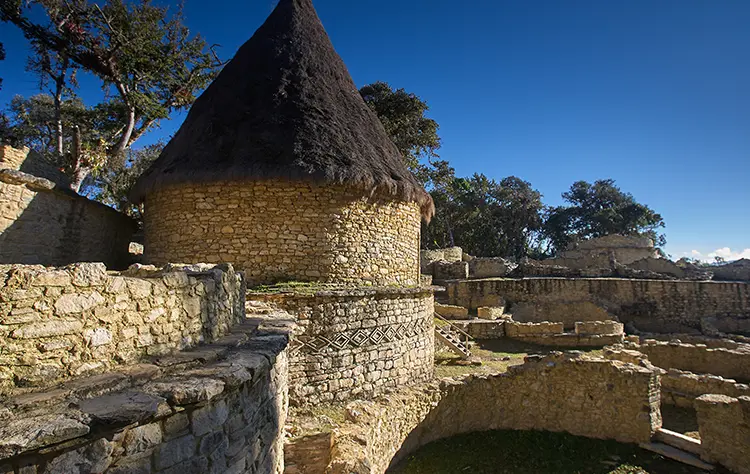
Start in the north, because almost no one does. For travelers looking at Peru beyond Machu Picchu, this is often the region that changes the whole conversation. In the Amazonas highlands, wrapped in cloud forest at around 3,000 meters, sits Kuélap, a walled stone citadel built by the Chachapoyas culture roughly between 900 and 1100 AD, centuries before the Inca pushed this far north. Its outer walls climb to nearly twenty meters, and inside lie the remains of more than 400 circular houses, many still carved with the zigzag and rhomboid friezes the Chachapoyas favored. People often call it the Machu Picchu of the north, which undersells both. After a section of the south wall collapsed in 2022, the site spent years under careful restoration, and that iconic outer wall was only returned to the visitor circuit in 2026. A cable car from Nuevo Tingo now lifts you up the final stretch in about twenty minutes, where there used to be a long climb through the mist.
One practical note that runs through this whole guide: since late 2024, Kuélap tickets are sold in advance through a state platform, capacity is capped, and on holidays and long weekends they go fast, so this is not a turn-up-and-walk-in kind of place. The region around it deserves a few days as well. Gocta, one of the tallest waterfalls in the world at over 770 metres, hides in the same cloud forest. At Karajía, a row of tall Chachapoyas sarcophagi, stands on a cliff ledge, staring out over the valley where they were set five centuries ago. The museum at Leymebamba holds hundreds of mummies recovered from a cliff above a remote lake, still wrapped, still unsettling in the best possible way.
A day west and the mood changes completely in Cajamarca, a green, dairy-rich highland city carrying a heavy weight of history. This is where the Spanish conquest of Peru effectively began. In 1532, Francisco Pizarro captured the Inca emperor Atahualpa here, and you can still stand in the Cuarto del Rescate, the room he is said to have filled with gold and silver in a failed attempt to buy back his freedom. Just outside town, the thermal pools of the Baños del Inca are the same waters the emperor was bathing in when the Spanish arrived. The north sees a fraction of the visitors the south does, which is exactly its appeal, but it also asks more in logistics, and it is the kind of place where the right local guide changes the entire trip.
Discover our northern Peru itineraries →
The Amazon: Tambopata, Manu, and Travel That Earns Its Keep
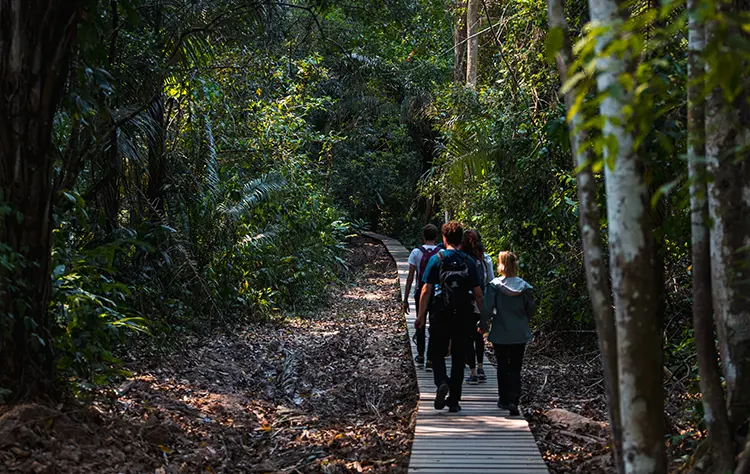
Peru holds a vast piece of the Amazon, and it is one of the country’s great undersold experiences, especially for travelers curious about Peru beyond Machu Picchu. Most travelers reach it through Puerto Maldonado and the Tambopata National Reserve, the accessible entry point and still wild enough to deliver. Mornings begin in the dark, gliding out to a clay lick where scarlet and red-and-green macaws gather by the hundreds, their noise arriving well before the light does. On the oxbow lakes, Sandoval and Tres Chimbadas, a family of giant river otters works the shallows, an animal that can reach nearly two meters and has gone rare almost everywhere it still survives.
For travelers willing to go further and slower, Manu is the deep end. A UNESCO biosphere reserve that drops from high Andean cloud forest all the way down to lowland jungle, it is one of the most biodiverse protected areas on the planet, with well over a thousand recorded bird species inside a single park. Reaching its core takes days, not hours, and that distance is the whole point. The further in you go, the less the forest performs for you and the more it simply carries on as if you were not there, which is the encounter many people are quietly hoping for.
This is the region where how you travel matters as much as where. The quality of an Amazon trip is decided almost entirely by your lodge and your field guide, the person who can pick a sleeping margay out of a tangle of branches at fifty meters. We weight our Amazon itineraries toward lodges with real conservation records and guides who grew up reading this forest, partly because it is the responsible way to be here and partly because it simply makes for a better trip. The handover from the cold of the high Andes to the heat of the basin is the sometimes-tricky part, and making those connections seem seamless is exactly the kind of thing that should stay invisible to you.
Discover our Amazon and wildlife itinerary →
Arequipa and Colca Canyon
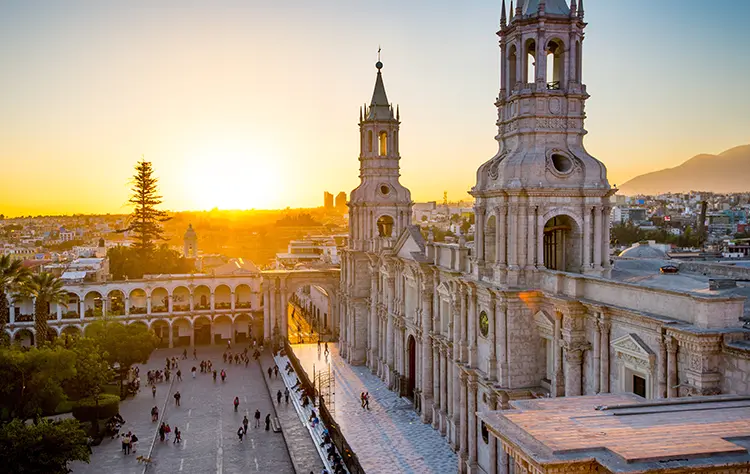
Fly south to Arequipa and another side of Peru beyond Machu Picchu begins to appear. They call it the White City, and the name is literal: the old center is built almost entirely from sillar, a pale volcanic stone quarried from the snow-dusted volcanoes that ring the town, among them the near-perfect 5,822-metre cone of El Misti. The historic center is a UNESCO World Heritage site, and its centerpiece, the Santa Catalina monastery, is a walled town within the town, founded in 1579 and washed in deep ochres and blues, where cloistered nuns lived for centuries along lanes named after Spanish cities. Arequipa is also where locals will insist the food rivals Lima, and they are not entirely wrong.
A few hours north, the land splits open into the vast Colca Canyon, one of the deepest in the world and more than twice the depth of the Grand Canyon. Its terraced walls have been farmed continuously since before the Inca, and the villages along the rim still hold tight to their traditions, down to the embroidered hats that tell you which community a woman comes from. The reason most people come, though, arrives on the morning thermals. At the Cruz del Cóndor viewpoint, Andean condors lift off the canyon floor and ride the warming air right past the edge, sometimes close enough that you hear the wind in their wings before you see them.
Colca Canyon rewards an overnight stay far more than the rushed day trip many operators still sell, partly for the condors at their best and partly because the altitude up here is serious and worth easing into. It is a landscape that does not need to shout, which, after the crowds of the southern circuit, can feel like its own kind of luxury.
Discover our Southern Peru itinerary →
Lake Titicaca and the Living Islands
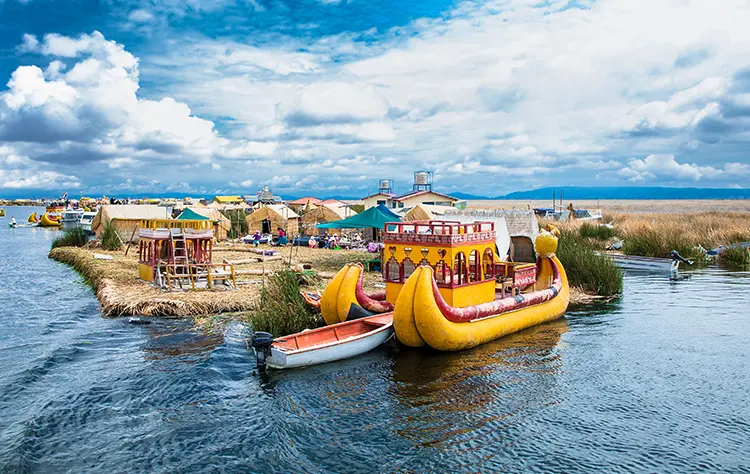
Higher still and further south, Lake Titicaca sits at around 3,800 meters, the highest navigable lake in the world, an inland sea so wide it has its own weather patterns and shares a border with Bolivia down the middle. The light up here is something else, hard and clear, and the water turns a blue that does not look quite real. Puno, the city on its shore, is Peru’s folklore capital, and with a little luck you will land on one of its huge, costumed dance festivals spilling through the streets.
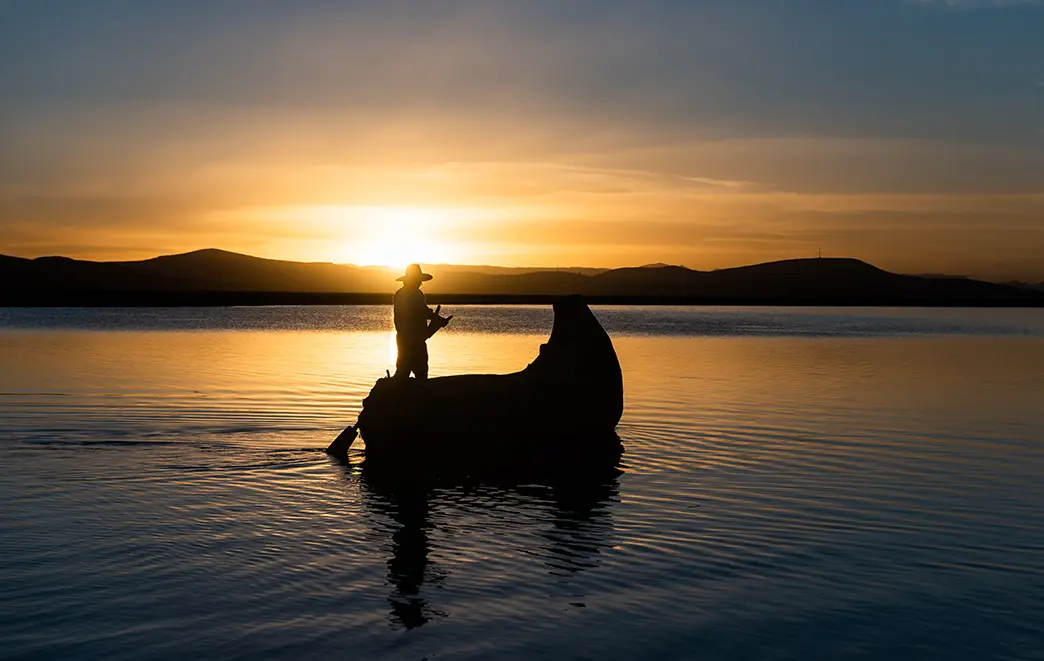
The lake’s real draw is its islands, and they are unlike anywhere else on earth. The Uros live on the water itself, on dozens of islands woven entirely from totora reeds that they patch and rebuild constantly as the bottom layers rot away beneath them. Further out, Taquile rises green and terraced from the water, a community where the men knit and whose textile tradition is refined enough that UNESCO recognized it as intangible cultural heritage. On Amantani, a little beyond, travelers can stay overnight in family homes, eat what the island grows, and watch a sky with almost no light pollution come out over the water.
These are easy places to get wrong, to be hurried through for a photograph and a sales pitch. Done properly, with a guide who has real relationships within these communities and enough time to slow down, Lake Titicaca turns into one of the most quietly moving stretches of the whole country.
Discover our Lake Titicaca itinerary →
The South Coast: The Nazca Lines and the Paracas Desert
Between Lima and the south runs a band of desert most people fly straight over, which is a little sad. This is where the Nazca Lines lie scratched into the floor of the pampa, hundreds of figures and geometric forms, some stretching for kilometers, drawn by the Nazca culture more than 1,500 years ago and only truly visible from a small aircraft, since they were never really meant for eyes at ground level. No one fully agrees on why they exist, which is part of the mystery surrounding them.
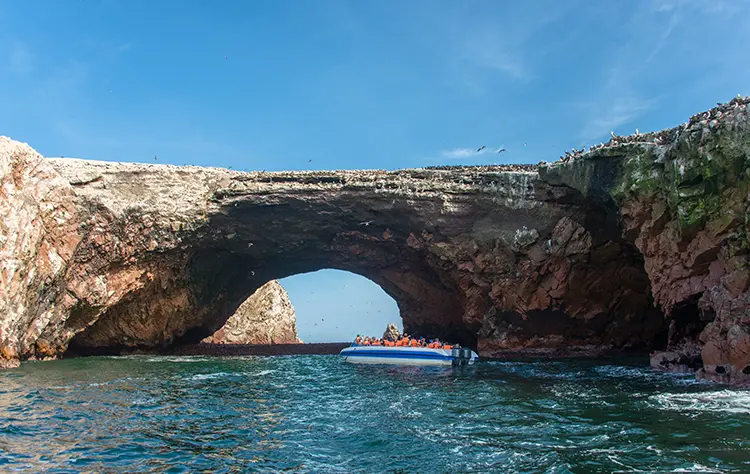
Closer to the coast, the Paracas peninsula sets raw desert against a cold, life-rich sea. The Ballestas Islands offshore swarm with sea lions and seabirds, and the Paracas National Reserve runs red cliffs straight down into the Pacific. It is a comfortable, low-altitude counterpoint to the thin air of the highlands, and it slots cleanly onto the front or back end of a southern itinerary for travelers who want something different without committing to a multi-day trek.
Discover our coastal and desert itinerary →
Designing a Journey Beyond the Classic Circuit
None of these regions runs on the smooth rails of the Cusco circuit. Flights are less frequent, the strong guides are concentrated in a handful of people, and sites like Kuélap now run on capped, pre-booked tickets that do not forgive a last-minute plan. That is the trade-off. The reward for the extra coordination is a version of Peru beyond Machu Picchu that almost no one else in your life will have seen, and our job is to make the logistics easy, so the north feels as effortless to you as the Sacred Valley does.
Because these areas are more sensitive to timing and availability, you will want to be sure to start planning early, which we get into properly in How Far in Advance Should You Plan a Trip to Peru?. And once the map of your trip makes sense, the next thing worth understanding is what holds all these regions together at the table, which we follow in A Culinary Journey Through Peru. Tell us which of these landscapes pulls at you, and we will weave it into a private itinerary that is perfect just for you.
Start planning your Peru journey →
FAQs
What can you see in Peru besides Machu Picchu?
A great deal, in every direction: the Chachapoyas fortress of Kuélap and waterfalls of the northern cloud forest, the Amazon reserves of Tambopata and Manu, the white city of Arequipa beside the vast Colca Canyon, Lake Titicaca’s high-altitude reed and textile islands, and the Nazca Lines on the southern desert coast.
Is Kuélap open to visitors in 2026?
Yes. After the 2022 wall collapse, Kuélap reopened in stages, and in 2026 the restored southern wall was returned to the visitor circuit. The cable car from Nuevo Tingo is running, but tickets are capped and sold in advance, so peak dates should be booked ahead.
Is northern Peru worth the extra travel?
For travelers who value solitude and pre-Inca history, it is very much worth the effort. Chachapoyas and Cajamarca see a small fraction of the southern circuit’s crowds, though they take more time and coordination to reach, so they suit a longer trip rather than a quick visit.
Should I visit the Peruvian Amazon from Tambopata or Manu?
Tambopata, reached from Puerto Maldonado, is the more accessible and comfortable option, and still excellent for macaws and giant otters. Manu is deeper, wilder, more rustic, and far more biodiverse, but reaching its core takes several days, so it rewards travelers who have the time and patience.
How many extra days do these regions need?
As a rough guide, allow at least three days for the Amazon, three for Arequipa and Colca Canyon, two for Lake Titicaca, two days for Nazca and Paracas, and three or more for the north. They are best added to the classic Cusco and Machu Picchu route, not squeezed into it.
Best Time to Visit Peru: When to Go by Region & Experience
Planning a journey to Peru is an exciting step toward exploring a land of extraordinary diversity, from the so...
Read Post
The Lost City Colombia and the Meaning of Reaching It
Some destinations are defined by what they are. Others by what it takes to reach them. The Lost City Col...
Read Post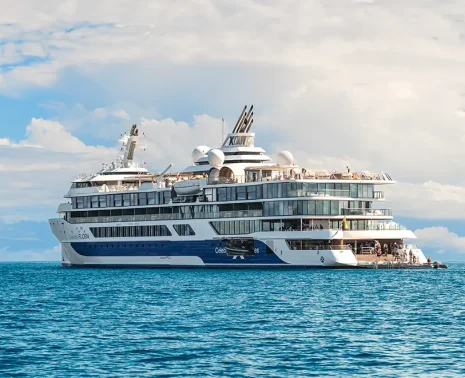
Best Galápagos Cruises: Choosing the Right Way to Experience the Islands
The phrase “best Galápagos cruises” suggests comparison. Ships, cabins, amenities, itineraries. It invite...
Read Post
8 DAYS
Luxury Machu Picchu Tours: Unveiling Peru’s Timeless Wonders
Cusco, Lima, Machu Picchu, Sacred Valley

8 DAYS
Peru Family Vacation: Journey to Machu Picchu and Beyond
Cusco, Lima, Machu Picchu, Sacred Valley

11 DAYS
Amazon River Cruise: A Luxury Journey Through the Amazon
Lima, Cusco, Sacred Valley, Machu Picchu, Iquitos, Amazon River