March 20, 2026 | by: Kuoda Authors


Why Cities Matter at the Edge of the Amazon
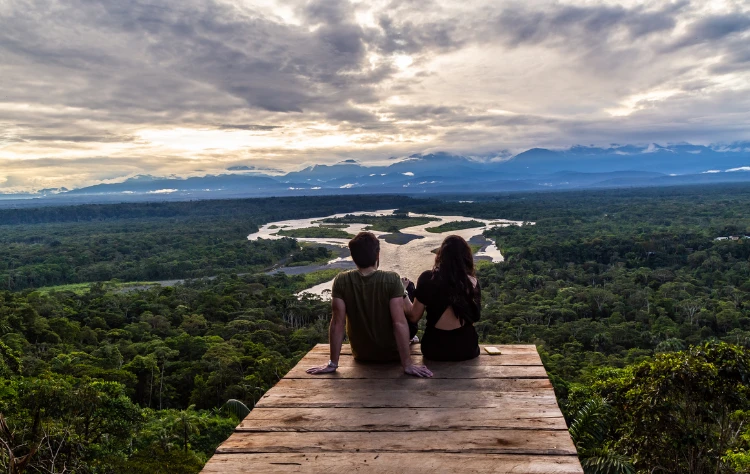
The Amazon rainforest is often imagined as vast and uninterrupted. In reality, it is approached through cities that exist in close relationship with the forest itself.
These cities are not staging grounds or logistical necessities alone. They are places where river systems dictate movement, where climate shapes architecture, and where modern life adapts continuously to one of the world’s most complex ecosystems.
For discerning travelers, understanding the cities near the amazon rainforest provides essential context. These urban centers reveal how people live alongside the forest rather than apart from it. Kuoda approaches Amazon journeys with this perspective, integrating cities as meaningful points of orientation rather than transitional afterthoughts.
The Amazon as a System, Not a Destination
The Amazon basin spans multiple countries and cultures. Its scale resists simplification.
Cities that border the rainforest function as cultural and logistical thresholds. They mark the shift from road to river, from urban infrastructure to ecological immersion. Approached thoughtfully, they prepare travelers for the rhythm and realities of the forest itself.
Kuoda designs Amazon journeys that honor this transition. Time in gateway cities is calibrated carefully, allowing travelers to adjust physically, mentally, and culturally before moving deeper into the rainforest.
Iquitos: River City Without Roads
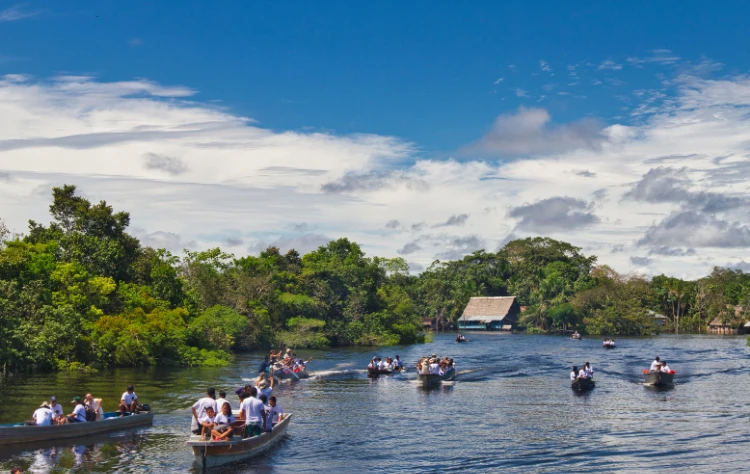
In northern Peru, Iquitos stands as one of the most distinctive cities near the Amazon rainforest.
Accessible only by air or river, Iquitos is shaped entirely by the Amazon’s tributaries. Daily life unfolds along the water. Markets, transport, and commerce reflect a river-based logic that predates modern infrastructure.
Kuoda introduces Iquitos as a point of orientation rather than distraction. Select riverfront accommodations and private transfers allow travelers to observe the city’s rhythms without excess movement. From here, journeys continue by boat to remote rainforest lodges where immersion replaces connectivity.
The transition feels natural, not abrupt.
Puerto Maldonado: Southern Amazon Gateway
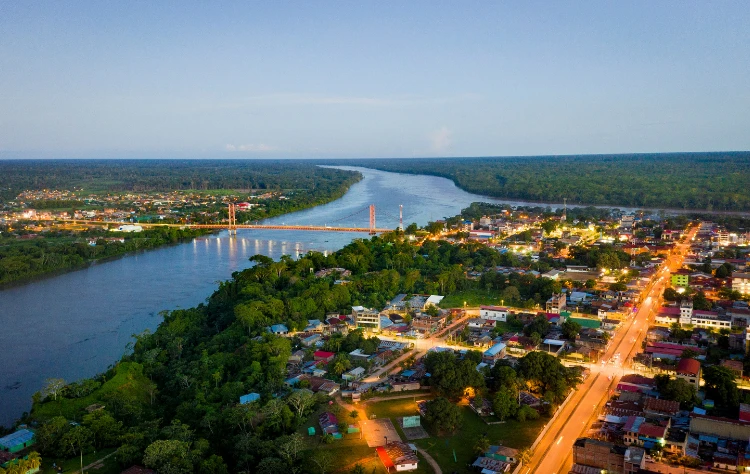
In southeastern Peru, Puerto Maldonado provides access to the Tambopata region and protected rainforest reserves.
Unlike river-bound Iquitos, Puerto Maldonado connects by road and air, creating a different relationship with the forest. Its position allows for relatively quick transition from city to lodge, often within hours.
Kuoda designs arrivals into Puerto Maldonado with intention. City time is minimal but purposeful. Transfers are private. Lodges are selected for their location, conservation practices, and sense of calm.
This approach allows travelers to move efficiently into the forest while maintaining comfort and continuity.
Cities Near the Amazon Rainforest Across Borders
The Amazon does not belong to one country, and neither do its gateway cities.
In Colombia, Leticia sits at the intersection of Colombia, Peru, and Brazil. The city’s multicultural character reflects centuries of trade and migration along the river.
Kuoda introduces Leticia as a cultural threshold. Encounters emphasize understanding of indigenous presence, border dynamics, and river life rather than sightseeing volume. From here, travelers continue into the forest by boat, where the river becomes both route and reference.
In Brazil, Manaus represents a larger, more complex urban center. While Kuoda’s focus remains on Spanish-speaking Amazon regions, Manaus illustrates how the rainforest and modern urban life coexist at scale.
Each of these cities near the Amazon rainforest offers a different lens on the same ecosystem.
Choosing the Right Gateway City
Selecting the appropriate Amazon gateway is a design decision, not a default.
Kuoda evaluates cities near the Amazon rainforest based on the traveler’s goals. Depth of immersion. Desired comfort level. Interest in wildlife, culture, or river systems. Sensitivity to travel time and transitions.
Some journeys benefit from longer river travel. Others prioritize swift access to protected reserves. Kuoda aligns these choices carefully, ensuring that the city supports the experience rather than complicating it.
Lodges, Rivers, and the Shift Into the Forest
From Amazon cities, the journey transitions quickly.
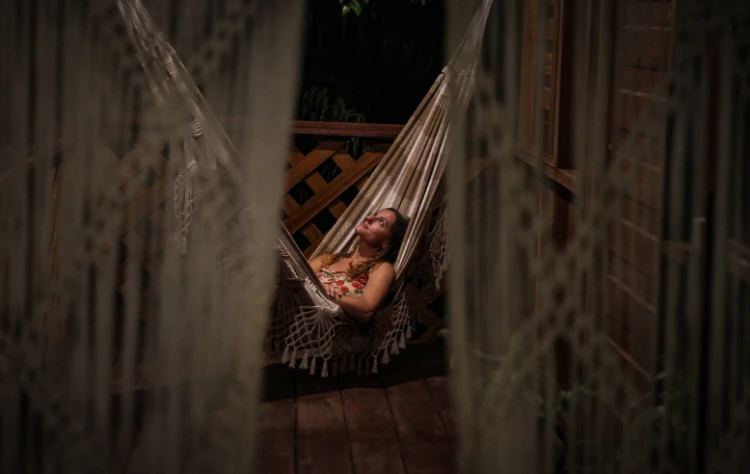
Riverboats replace vehicles. Sound shifts from engines to insects and water. Light becomes filtered and directional. Lodges selected by Kuoda offer refined comfort without separation from the environment.
This transition is where thoughtful design matters most. When handled well, the move from city to forest feels inevitable rather than dramatic.
Kuoda ensures that this passage unfolds smoothly, preserving energy and attention for what follows.
Sustainability and Community at the Forest’s Edge
Cities near the Amazon rainforest are deeply connected to the health of the surrounding ecosystem.
Kuoda partners with lodges and local operators that prioritize conservation, research, and community engagement. Travel is designed to support long-term stewardship rather than short-term access.
Through responsible travel practices and initiatives connected to the Kaypi Kunan Foundation, Kuoda contributes to cultural and environmental continuity across South America’s Amazon regions.
Here, sustainability is structural rather than performative.
Frequently Asked Questions
What are the main cities near the Amazon rainforest?
Key cities include Iquitos and Puerto Maldonado in Peru, Leticia in Colombia, and Manaus in Brazil. Kuoda focuses on gateways that best support immersive, well-paced journeys.
Do travelers need to spend time in these cities?
Time in Amazon gateway cities is typically brief but intentional. Kuoda designs stays that provide orientation without detracting from rainforest immersion.
How quickly can travelers reach the rainforest from these cities?
Depending on location, transfers to lodges range from one to several hours by boat or road. Kuoda manages these transitions privately and efficiently.
Can Amazon city stays be combined with other regions?
Yes. Kuoda integrates Amazon journeys seamlessly with the Andes, Sacred Valley, or Galápagos when it supports the journey’s overall coherence.
Where the Forest Begins Gradually
The Amazon does not begin at a single point. It begins through transition.
Cities near the Amazon rainforest mark that shift. From paved streets to riverbanks. From schedules to cycles. From observation to immersion.
Kuoda’s role is to guide travelers through that threshold with care. Designing journeys where cities provide context, the forest offers perspective, and the experience unfolds without friction.
When approached thoughtfully, the Amazon reveals itself not as a destination entered abruptly, but as a world eased into, one river mile at a time.
Peru Travel Advisory: How Local Expertise Transforms Information Into Confidence
Reading Peru Clearly, Not Cautiously Travel advisories are tools. They are broad by design, written to apply ...
Read Post
Peru Family Tours: Designing Journeys That Engage Every Generation
Family Travel as a Shared Experience, Not a Compromise Travel changes when families travel together. Not ...
Read Post
Luxury Travel to Galápagos Islands: When Access Is Guided by Understanding
Why the Galápagos Require a Different Definition of Luxury The Galápagos Islands are not a destination that...
Read Post
8 DAYS
Luxury Machu Picchu Tours: Unveiling Peru’s Timeless Wonders
Cusco, Lima, Machu Picchu, Sacred Valley

8 DAYS
Peru Family Vacation: Journey to Machu Picchu and Beyond
Cusco, Lima, Machu Picchu, Sacred Valley

11 DAYS
Amazon River Cruise: A Luxury Journey Through the Amazon
Lima, Cusco, Sacred Valley, Machu Picchu, Iquitos, Amazon River