February 18, 2026 | by: Kuoda Authors


A Festival That Resists Simplification
High in the southern Andes, a few hours from Cusco, the town of Paucartambo gathers each July for a celebration that is often photographed, occasionally explained, and rarely understood in full.
The paucartambo festival is not a single event, nor is it easily summarized. It is a layered expression of faith, history, satire, and communal memory centered on the devotion to the Virgen del Carmen, the town’s patron saint. For local families, dancers, and musicians, this is not a performance staged for visitors. It is a living tradition, renewed annually through discipline, preparation, and reverence.
For travelers who seek cultural depth rather than spectacle, Paucartambo offers a rare opportunity to witness how ritual continues to shape contemporary life in the Andes.
Why the Festival Matters Beyond the Pageantry
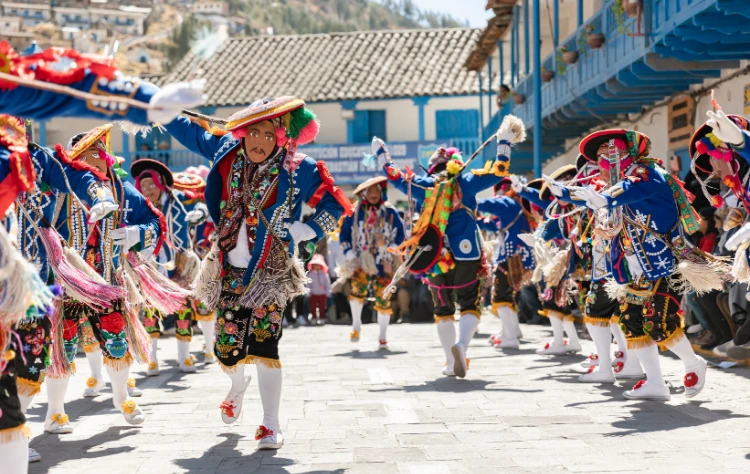
At first glance, the festival appears exuberant. Masked dancers fill the narrow colonial streets. Music echoes through the plaza day and night. Costumes shimmer with embroidery, mirrors, and symbolism.
Yet beneath the movement lies structure and meaning. Each dance represents a social role, a historical moment, or a moral tension. Spanish colonizers, indigenous warriors, devils, angels, merchants, and tricksters all take form through choreography that has been preserved and refined across generations.
The paucartambo festival matters because it is not static folklore. It evolves while remaining anchored in collective memory. The town does not pause normal life to host the festival. Life reorganizes itself around it.
The Virgen del Carmen and Andean Faith
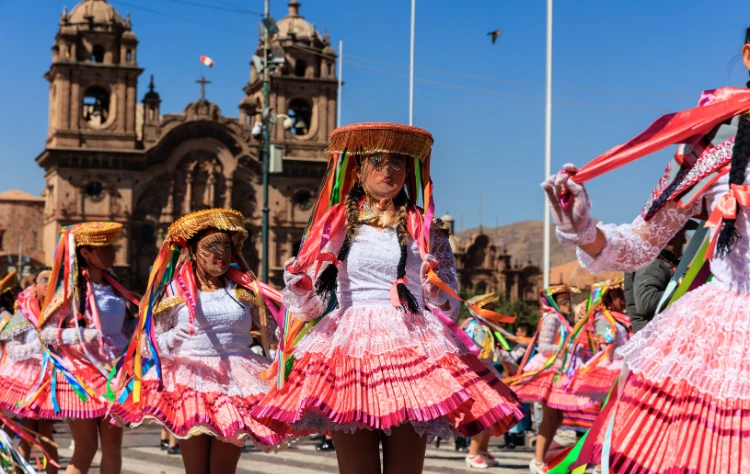
Devotion to the Virgen del Carmen arrived with Spanish colonialism, but in Paucartambo it became something distinctly Andean. Catholic iconography merged with pre-Hispanic cosmology, creating a spiritual framework that feels both intimate and expansive.
Processions honor the Virgin as protector and guide, yet the rituals surrounding her reflect local values of reciprocity, endurance, and communal responsibility. Faith here is not abstract. It is enacted through physical effort. Dancers train for months, often carrying heavy costumes at high altitude, not for recognition, but as an offering.
This quiet seriousness is what sets the festival apart. Celebration exists alongside discipline.
The Dances as Cultural Narrative
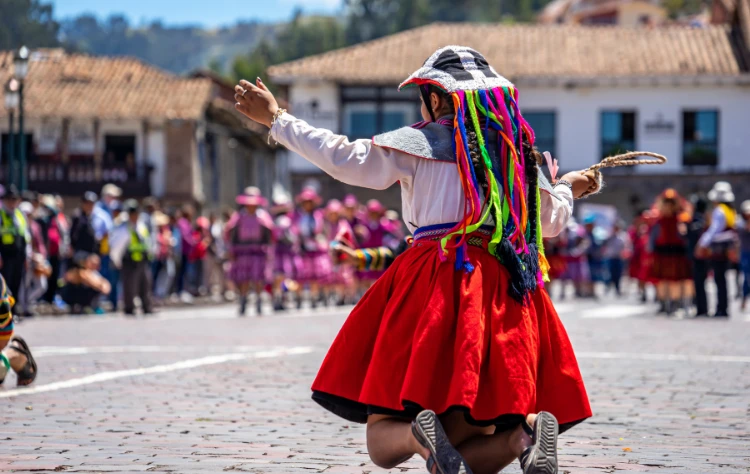
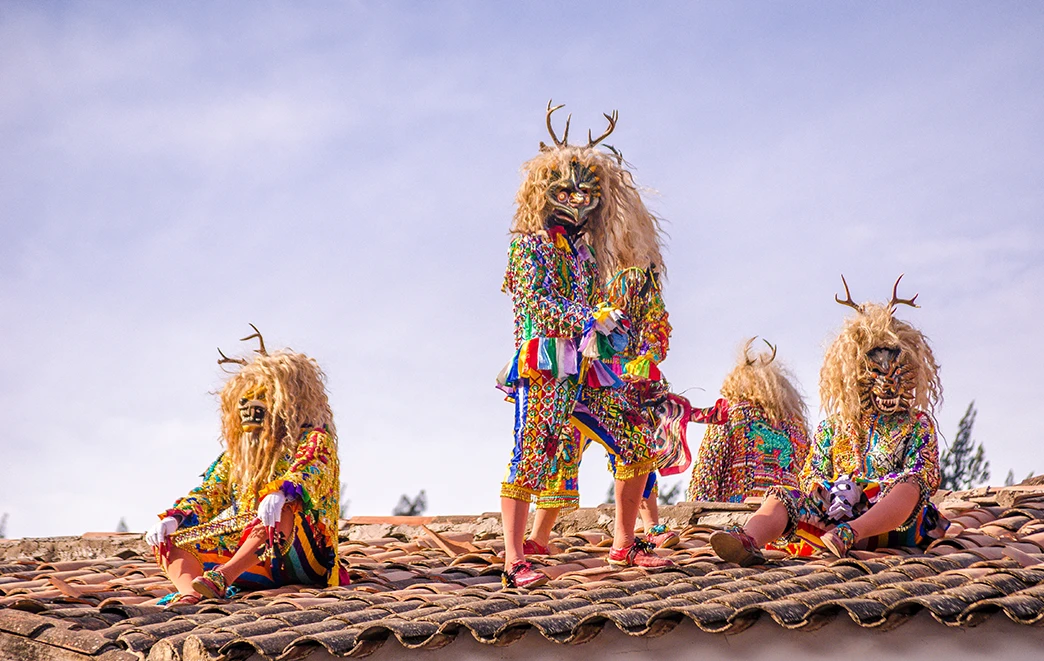
Among the many dances performed during the festival, some are instantly recognizable, others deliberately unsettling. The Saqra, with horned masks and agile movements across rooftops and balconies, embody moral ambiguity rather than simple transgression. They mock authority, challenge order, and remind viewers that chaos and balance coexist.
Other dances reference colonial power structures, indigenous resistance, and social hierarchies that still echo today. These are not reenactments designed to explain history to an audience. They are embodied memories, passed down through families and dance fraternities.
For the attentive observer, the festival becomes a moving archive of Andean identity.
Paucartambo as Place, Not Backdrop
The town itself shapes the experience. Paucartambo’s stone streets, whitewashed facades, and compact layout create intimacy. There is no separation between performers and residents. Dancers rest on doorsteps. Musicians gather in courtyards. Altars appear in private homes.
This proximity reinforces the sense that visitors are stepping into something ongoing rather than arriving for a scheduled event. Timing, positioning, and guidance matter greatly. Without context, the festival can feel overwhelming. With thoughtful planning, it becomes legible.
This is where Kuoda’s local expertise is essential. Understanding when to observe quietly, when to engage, and when to step back allows the experience to remain respectful and coherent.
Experiencing the Festival with Intention
Kuoda does not frame the paucartambo festival as a highlight to be consumed quickly. It is approached as part of a broader cultural journey through southern Peru. Travel is paced to allow acclimatization, reflection, and rest. Accommodations are selected for comfort and location, avoiding unnecessary intrusion into local spaces.
Private guides with deep regional knowledge provide context without commentary overload. They explain symbolism when asked and allow silence when observation feels more appropriate. Logistics are handled discreetly, allowing travelers to move through the festival without distraction.
The result is not immersion by force, but understanding by proximity.
Sustainability and Community Context
Large festivals place strain on small towns. In Paucartambo, local authorities and communities manage visitor numbers and access carefully. Respect for these boundaries is essential.
Kuoda’s approach aligns naturally with this ethos. Small-group or private travel minimizes disruption and supports local economies in a measured way. Community engagement, including initiatives connected to the Kaypi Kunan Foundation, focuses on long-term relationships rather than one-time visibility.
Sustainability here is practical and unspoken, rooted in respect rather than messaging.
Frequently Asked Questions
What is the paucartambo festival?
The paucartambo festival is an annual religious and cultural celebration honoring the Virgen del Carmen, held each July in Paucartambo, Peru. It combines dance, music, ritual, and community participation.
When does the Paucartambo Festival take place?
The main celebrations typically occur around July 15th to 18th, though preparation and smaller rituals extend beyond these dates.
Is the festival appropriate for luxury travelers?
Yes, when experienced with thoughtful planning. Kuoda designs private itineraries that prioritize comfort, context, and respectful engagement with the festival.
Can the festival be combined with other experiences in Peru?
Absolutely. The paucartambo festival pairs naturally with time in Cusco and the Sacred Valley, creating a culturally rich journey without rushed transitions.
Witnessing, Not Consuming
The Paucartambo Festival does not ask to be photographed, summarized, or explained away. It asks for attention.
For travelers willing to observe with patience and humility, it offers insight into how tradition survives not by freezing itself in time, but by being lived fully, year after year. Kuoda’s role is simply to make space for that encounter. Quietly, seamlessly, and with care.
It is not an experience to collect. It is one to witness, and then carry with you long after the music fades.

Christmas in Chile: Traditions, Weather & Where to Go
There is a distinct magic that settles over Chile as December unfolds. Stretching from the hyper-arid north to...
Read Post
Bucket List Luxury Trips Peru and the Difference Between Seeing a Destination and Experiencing It Deeply
Peru appears on many travelers’ bucket lists long before they ever arrive there. For some, the image is i...
Read Post
Bolivia Cultural Immersion and the Difference Between Visiting and Understanding
Bolivia is not a destination that reveals itself easily from the surface. Travelers can move through the co...
Read Post
8 DAYS
Luxury Machu Picchu Tours: Unveiling Peru’s Timeless Wonders
Cusco, Lima, Machu Picchu, Sacred Valley

8 DAYS
Peru Family Vacation: Journey to Machu Picchu and Beyond
Cusco, Lima, Machu Picchu, Sacred Valley

11 DAYS
Amazon River Cruise: A Luxury Journey Through the Amazon
Lima, Cusco, Sacred Valley, Machu Picchu, Iquitos, Amazon River