January 30, 2026 | by: Kuoda Authors


Where Time Moves Grain by Grain
Some landscapes announce their importance through scale. Others reveal it through repetition.
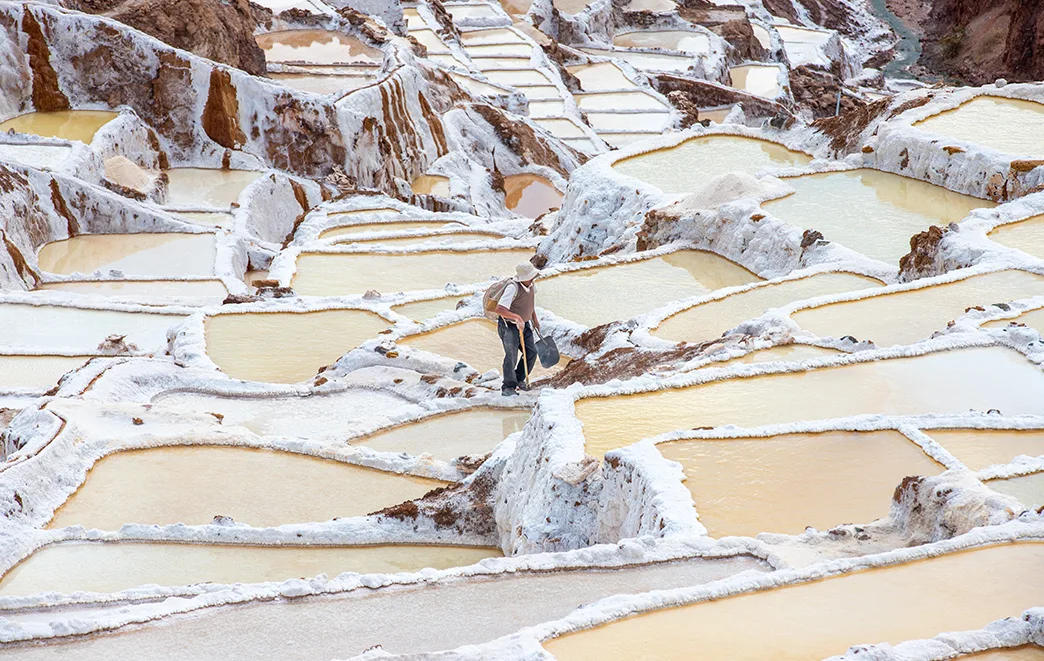
The salt mines Peru is known for are not defined by depth or machinery, but by surface and rhythm. In the Sacred Valley, thousands of shallow pools catch sunlight and water in equal measure, producing salt through a process that has remained largely unchanged for centuries.
This is not an industrial site. It is a communal system. One that rewards attention and resists speed.
The Setting: Maras and the Sacred Valley

The most recognized salt mines in Peru are located near the village of Maras, high above the Urubamba Valley. Known locally as Salineras de Maras, the site unfolds across a steep hillside fed by a natural underground salt spring.
As the water flows downward, it is channeled into individual pans. Over time, evaporation leaves behind crystalline salt, harvested by hand and redistributed through a system of inherited rights.
The visual impact is immediate, yet the deeper significance emerges only with context.
An Andean System of Engineering
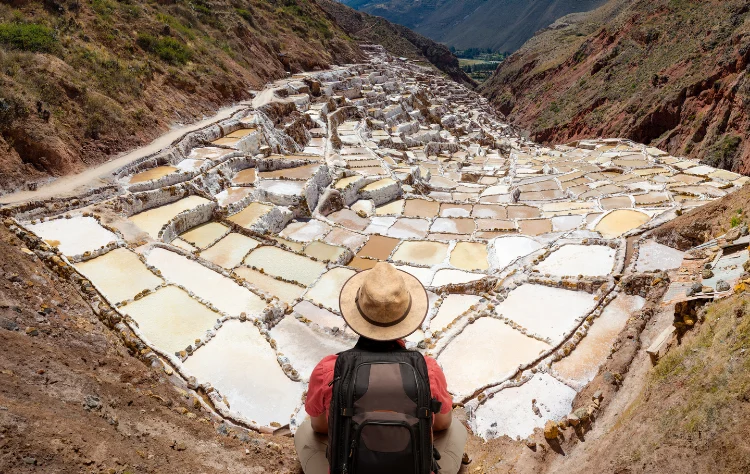
The salt pans are often described as ancient, and they are. Their origins predate the Inca, though the system was later incorporated into the imperial economy. What makes them remarkable is not age alone, but design.
Gravity governs the flow. Stone channels divide water precisely. Each pool belongs to a family, passed down across generations. Maintenance is constant, quiet, and essential. There is no central authority managing production. The system functions through shared understanding.
For travelers accustomed to large-scale infrastructure, this decentralized precision offers a different model of sustainability. One built on cooperation rather than control.
Why the Salt Mines Matter Culturally
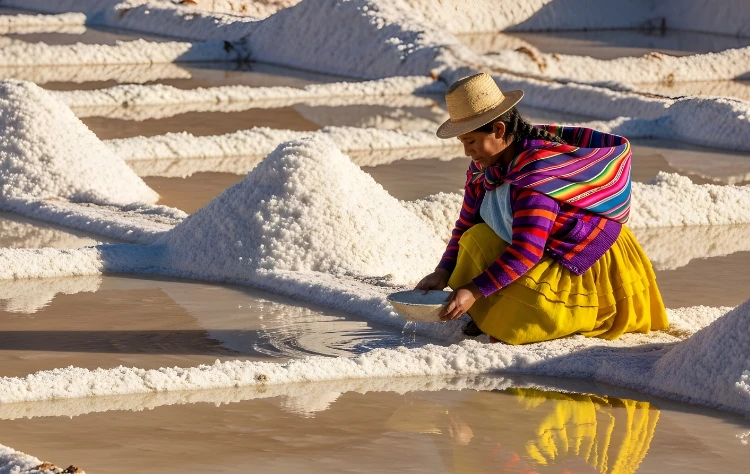
The salt mines Peru preserves at Maras are not preserved as artifacts. They are active. Families continue to harvest salt according to seasonal rhythms, adapting to climate variations without abandoning tradition.
Salt here is not symbolic. It is practical. Used locally, traded regionally, and valued for its mineral content and texture. The work remains labor-intensive, reinforcing a connection between land and livelihood that has not been abstracted away.
This continuity matters. It demonstrates how Andean communities maintain relevance without spectacle.
Visiting With Context
Maras is often included in Sacred Valley itineraries, yet the experience varies widely depending on approach. Without guidance, the salt pans can feel purely visual. Striking, but opaque.
Kuoda approaches the site as a cultural landscape rather than a stop. Visits are timed carefully to avoid crowding and to align with light and activity. Private guides explain the system in human terms. Who owns which pans. How disputes are resolved. Why some pools rest while others are harvested.
The result is understanding rather than accumulation.
The Sensory Dimension
The salt mines are quiet. Sound carries differently across the terraces. Footsteps echo lightly. Wind moves across water and stone.
Light shifts constantly, altering the color of the pools from pale white to soft pink and amber. The smell is mineral, clean, and subtle. There is no machinery. No urgency. Work unfolds steadily, shaped by weather rather than schedule.
This sensory restraint aligns naturally with Kuoda’s philosophy of effortless luxury. Nothing competes for attention. Everything belongs.
How Kuoda Integrates the Experience
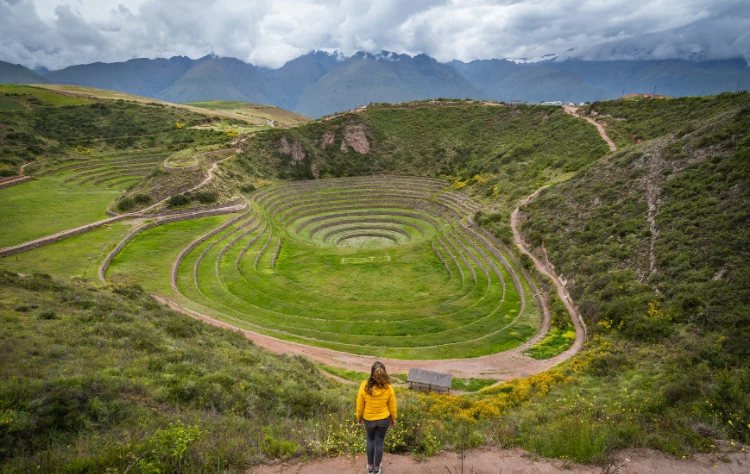
Kuoda does not treat the salt mines Peru is known for as a highlight to be rushed through. They are integrated into broader Sacred Valley journeys that prioritize flow and coherence.
Private transfers eliminate logistical friction. Visits may be paired with time in nearby villages or agricultural terraces, reinforcing the region’s layered relationship with land. Accommodations nearby offer space to rest and reflect, rather than pushing onward immediately.
As a local experience curator based in Cusco, Kuoda designs these moments with familiarity rather than novelty.
Stewardship and Sustainability
The Salineras de Maras face increasing pressure from tourism and climate change. Responsible access is essential to their survival.
Kuoda’s approach emphasizes small-scale visitation, clear pathways, and respect for local regulations. Engagement supports families who continue to maintain the pans, rather than extracting value through volume.
This aligns with Kuoda’s broader commitment to climate-positive travel and community engagement, including work through the Kaypi Kunan Foundation. Sustainability here is structural, not performative.
Frequently Asked Questions
What are the salt mines Peru is famous for?
The most well-known salt mines Peru offers are the Salineras de Maras, located in the Sacred Valley near Cusco, where salt is harvested through an ancient evaporation system.
Are the salt mines still in use?
Yes. Families continue to harvest salt using traditional methods, maintaining a living system rather than a preserved site.
How should travelers visit the salt mines?
Visits are best experienced with local context and thoughtful timing. Kuoda ensures private access, cultural explanation, and respectful engagement.
Can the salt mines be combined with other Sacred Valley experiences?
Absolutely. Kuoda often integrates Maras with nearby villages, archaeological sites, or countryside stays to create a balanced Sacred Valley itinerary.
A Place That Rewards Attention
The salt mines Peru protects at Maras do not impress through scale or drama. They endure through care.
For travelers willing to slow down, they offer insight into how Andean communities have long balanced resource use with collective responsibility. The landscape is not frozen in time. It is active, patient, and precise.
Kuoda’s role is simply to ensure that this encounter unfolds with clarity and respect. Allowing the salt pans to speak quietly for themselves.
A Thoughtful Trip to Buenos Aires, Shaped by Culture, Rhythm, and Care
Buenos Aires does not try to impress. It reveals itself gradually. At first, the city feels familiar. Europ...
Read Post
Attractions in Quito Ecuador: Reading the City Through History, Altitude, and Everyday Life
A City That Reveals Itself Slowly Quito does not announce itself all at once. Set high in the Andean foothill...
Read Post
Family Travel Colombia, Designed With Care and Perspective
Family travel changes as children grow. At a certain point, travel is no longer about keeping everyone occu...
Read Post
8 DAYS
Luxury Machu Picchu Tours: Unveiling Peru’s Timeless Wonders
Cusco, Lima, Machu Picchu, Sacred Valley

8 DAYS
Peru Family Vacation: Journey to Machu Picchu and Beyond
Cusco, Lima, Machu Picchu, Sacred Valley

11 DAYS
Amazon River Cruise: A Luxury Journey Through the Amazon
Lima, Cusco, Sacred Valley, Machu Picchu, Iquitos, Amazon River