May 21, 2021 | by: Molly Krifka


Did the Incas have a writing system? The surprising and peculiar answer is both yes and no. Quechua, the official Inca language and still one of Peru’s official languages, does not have a written counterpart. In other words, Quechua has always been a primarily oral language, resulting in ongoing academic discrepancy over its alphabet and spelling to this day.
Given these debates over the Quechua alphabet and linguistic analysis, there is more than one way to spell most Quechua words; and the word khipu, or quipu (using its other spelling), is no exception. But what is a khipu, and what does it have to do with the Inca writing system if they didn’t have an alphabet?
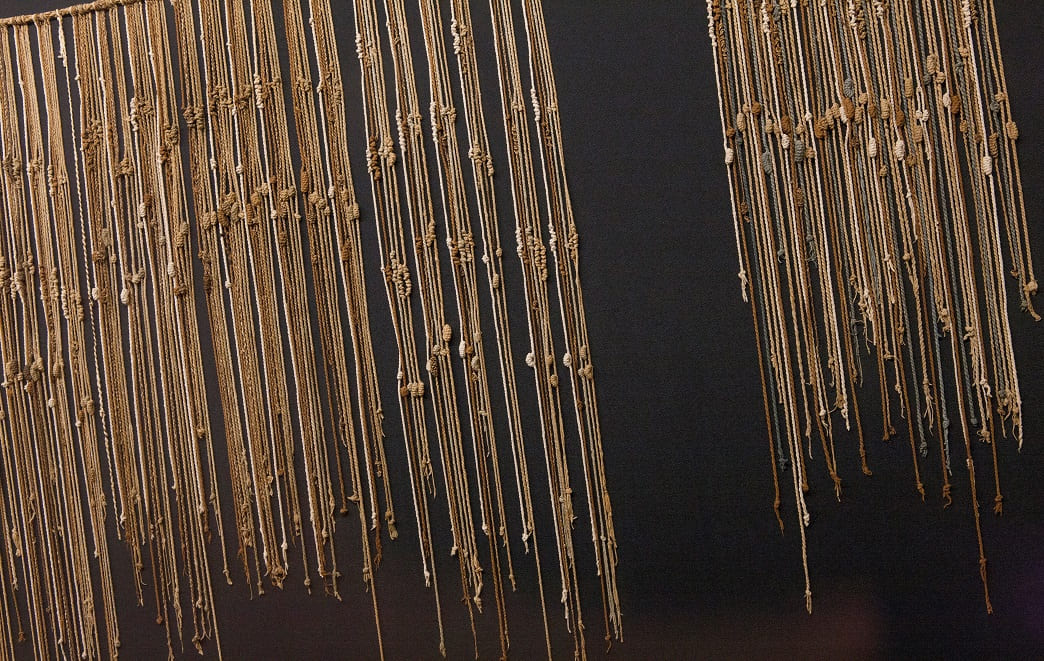
Put simply, a khipu is a “knot-record,” or a device that records and shares a vast array of complex information using hundreds of distinct knots. These knots are tied along vertical cords or strings and vary in color, shape, size, and sequencing. Therefore, as the Quechua alphabet is still up for debate, the khipu remains one of the Incas’ most fascinating inventions of communicative nature. Let’s learn more about the khipu, shall we?!
This article focuses on how the khipu (quipu) system functioned as a method of recording and transmitting information within the Inca Empire. While scholars continue to explore whether quipus encoded deeper layers of meaning beyond numbers, understanding the mechanics and social context of the system itself is essential before engaging with those interpretations.
1. How did the khipu system function?
Looking at the intricately knotted khipu strings splayed out on a table or wall in its iconic arc shape, you might be surprised to learn about the complex quantitative and qualitative data locked away in such a cryptic package. Objectively speaking, khipus are quite beautiful. The khipu presents an ornate wall decoration to a modern untrained eye or even a ceremonial necklace (depending on the khipu’s size).
However, the khipu system itself actually revolved around a highly concrete mathematical understanding of decimal positioning. This means that each string in the khipu (upwards of 1500 strings in the larger khipus) was created and read in reference to the principal string, thereby representing individual numbers or units altogether. The largest decimal in the khipu is 10,000! These are often referred to as quantitative khipus and were mainly used for tax registration and censuses within the Inca Empire.
These forms are often referred to as quantitative khipus and were primarily used for census data, taxation, and administrative organization within the Inca Empire. Their effectiveness depended not only on numerical structure, but on trained interpretation within a centralized system of governance.
2. How did the khipus travel, and who read them?
Inca communication via khipus was not universally accessible. Not everyone in Inca society could assemble and read a khipu because this was generally reserved for someone called a khipukamayuq (knot-maker, or khipu master).
Khipukamayuqs (also spelled quipucamayoqs) traveled to different corners of the empire, collecting information first, then creating the khipus based on this information, and finally handing the khipus over to individuals called chaskis (also spelled chasquis), who were in charge of transporting the khipus and many whom could read and translate the particular khipus they carried.
And these chaskis could run. They ran through some of the world’s most extreme terrains – the Andes’ glacial peaks and mountain valleys. With the khipus hanging and swinging from each shoulder, the chaskis were some of the most vital and trusted individuals in the Inca Empire.
The existence of specialized readers and messengers highlights a defining feature of the khipu system: information did not exist independently of people. Accuracy, meaning, and authority relied on human memory, training, and accountability, not on written texts that could circulate on their own.
3. Are khipus unique to the Incas?
Khipus have been compared with other physical mathematic devices, such as the abacus. However, this system of knot writing is 100% unique to the cultures of the Andes. This said, it is a common misconception that khipus were initially devised and used by the Incas during their rise to power. The oldest khipu dates back to 5,000 years ago, proving that they were used by some of the large civilizations predating the Incas as well.
The Inca contribution was not the invention of the khipu itself, but its refinement into a highly structured system capable of managing vast territories, complex taxation, and social organization without written records.
4. Where can you see the original khipus in Peru today?
While hundreds of original khipus survive today in museum and private collections around the world, encountering them without context reveals little. Their significance becomes clear only when viewed alongside historical explanation and cultural interpretation.
In Lima, you can find original khipu in the Museo de Arte de Lima (MALI), the Museo Larco, and the Museo Nacional de Arqueología, Antropología, e Historia de . You can also get up close and personal with these knotted wonders in Cusco in the Museo MachuPicchu – Casa Concha, which also has many of the original artifacts found in Machu Picchu.
As much as we know about the khipu today through careful archaeological, linguistic, and mathematical analysis, there is still so much mystery tucked away in each knot sequence. Thought initially to primarily record and share numerical data, like censuses, statistics, and accounts, we now know they were also used to express abstract and creative thoughts, stories, narratives, and even philosophy. We just still don’t know how to read these Inca symbols represented through numerical knot sequencing.
Some scholars argue that certain khipus may have encoded structured meaning beyond numerical data, raising deeper questions about communication without alphabetic writing. This perspective is explored in greater depth in our article on the quipu knot alphabet, which examines how meaning may have been organized through knots, color, and structure rather than letters.
For travelers interested in encountering original khipus in context, Kuoda curates private, well-paced journeys that allow time for guided interpretation and reflection. With expert local guides, these encounters become conversations rather than displays.
Carnaval Ecuador: A Cultural Celebration Best Experienced From the Inside
Carnaval in Ecuador is not one celebration. It is many, unfolding simultaneously across regions shaped by alti...
Read Post
Top Things to Do in Ecuador: Tailor‑Made Journeys with Kuoda
Ecuador welcomes you with unexpected diversity ‑ shimmering Pacific beaches, verdant cloud forests, Andean p...
Read Post
Wine Trips in South America: Luxury Journeys Through Vineyards and Valleys with Kuoda
For discerning travelers, wine is more than a drink, it is a story of land, climate, culture, and tradition. S...
Read Post
8 DAYS
Luxury Machu Picchu Tours: Unveiling Peru’s Timeless Wonders
Cusco, Lima, Machu Picchu, Sacred Valley

8 DAYS
Peru Family Vacation: Journey to Machu Picchu and Beyond
Cusco, Lima, Machu Picchu, Sacred Valley

11 DAYS
Amazon River Cruise: A Luxury Journey Through the Amazon
Lima, Cusco, Sacred Valley, Machu Picchu, Iquitos, Amazon River